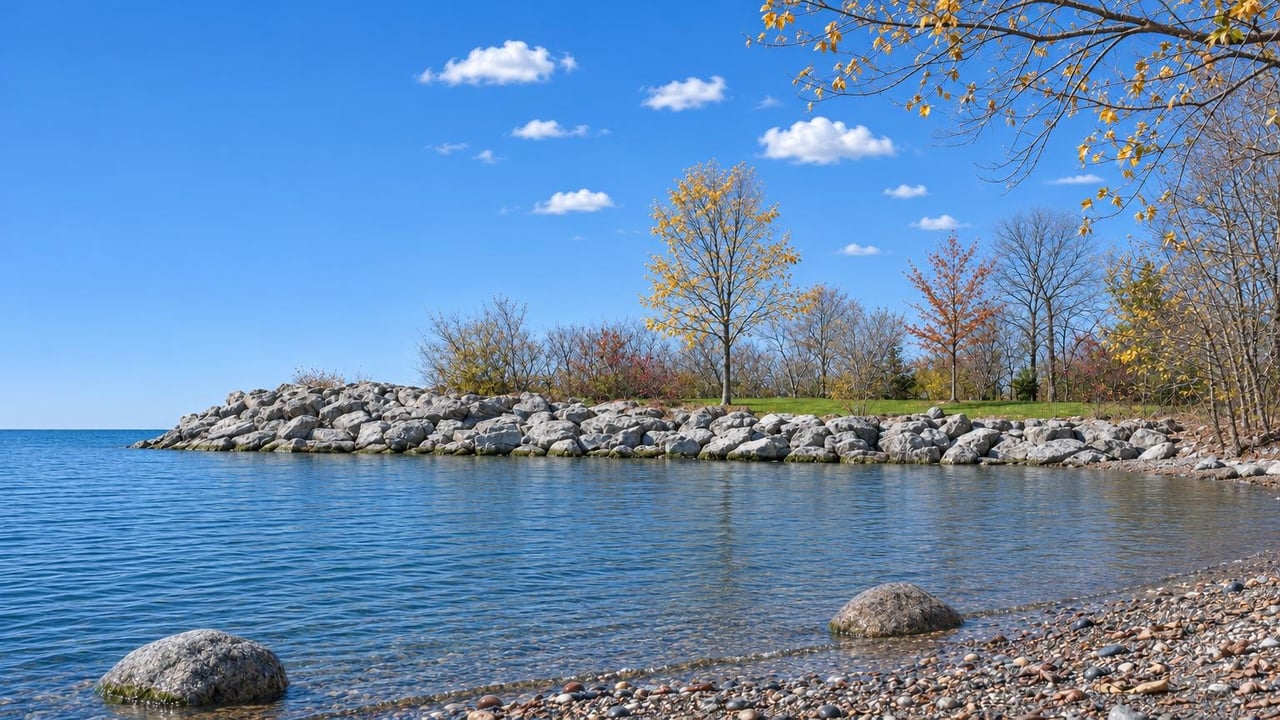
Lorne Park Estates is 83 homes on about 80 acres of Lake Ontario shoreline. The Lorne Park Estates Association owns almost everything outside the private lot lines. According to the association's own description, that means every road, the road allowances and rights of way, the woods, the lake frontage, the beaches, the water lots, the central commons and the structures that sit on them. When you buy a house here, you also take on a share of an 80-acre park that the owners run together.
That changes how you price a home in the enclave. On most lakefront streets in South Mississauga, the gap between neighbouring sale prices comes from water: whether a lot touches the lake, how much frontage it has and what the view is. In Lorne Park Estates, the beach and the shoreline belong to the association. Every member home has the same claim on them, so the shared assets do not explain why one house sells for more than another. The price difference comes from the house and its private lot, and the 2026 market has not been generous to houses priced on reputation alone.
The park in numbers
The association lists 42 acres of woodland, 2,500 feet of shoreline, three creek beds and marsh areas, and about 3 kilometers of footpaths. It also has a tennis court, a skating rink, a fire pit, children's swings, a playground gazebo and a lake promenade. It counts 220 bird species and about 300 kinds of plants and wildflowers on the grounds.
Divide those figures by 83 homes and you get roughly half an acre of woodland and about 30 feet of Lake Ontario shoreline for each home. The association holds the land as a whole, and no house owns its own slice. Still, the arithmetic gives a buyer a fair sense of scale. A house set well back in the trees has the same claim on the beach and the promenade as the house closest to the water.
The association was founded in 1948, and its homepage lists the roads, forests and recreational facilities among what its members look after. A buyer here is joining the group that keeps the park running as well as buying a house, and the association describes the Park as "a neighbourhood of friends."
How a steamer resort became a co-op
The shared ownership comes out of the Estates' history, and that history explains why the commons are so large. Heritage Mississauga dates the first hotel and wharf, built by J.W. Orr, to 1877. On May 24, 1879, Queen Victoria's birthday, a group of businessmen opened Lorne Park as a 75-acre pleasure ground about a 90-minute cruise west of Toronto Harbour. Visit Mississauga's history of the Estates reports that more than 8,000 people came on opening day.
The Toronto-Lorne Park Summer Resort Company bought the grounds in 1886. Its architect, Edmund Burke, reopened the hotel as Hotel Louise in 1889 and designed 27 cottages, many of them with wrap-around verandahs. Massawippi Cottage and Glenview Cottage are two of the names that survive from that period. In 1909 ownership passed to The Lake Shore Country Club, which converted Hotel Louise into the Lakeshore Country Club.
The arrangement in place today began in a courtroom. Between 1912 and 1914, a ruling left cottagers owning their own lots and sharing the cost of keeping up the Park. In 1919, Mary Louise Clarke, daughter of early investor James Boustead, worked with five other cottagers to design a cooperative structure they called Lorne Park Estates. Clarke bought the unsold lots to cover the company's debts. Her estate kept paying the Park's annual fees on those lots after her death in 1931, until the association formed in 1948 and gave the cottage owners control of the park lands.
Today the association still governs and manages the community cooperatively. Residents own their house lots and the association owns the rest of the 80 acres, and a white picket "Lorne Park Estates, private road" sign stands at the entrance to Tennyson Avenue.
What the May sale says about pricing
If the shared assets are the same for every house, then the price of any one sale reflects the house. The clearest 2026 example is 905 Sangster Avenue. INsauga reported that the four-bedroom Lorne Park Estates home sold in May 2026 for $3,061,020, against a list price of $3,499,900. It has more than 6,000 square feet of living space and floor-to-ceiling glass walls. It also won Toronto Life's Best New House and an urban design award from the City of Mississauga.
The sale closed at about 87.5% of asking. For comparison, Mississauga detached homes closed at an average of 97% of list in October 2026, with 200 detached sales and an average of 32 days on market. The Toronto Regional Real Estate Board's October 2026 Market Watch put the city's detached benchmark at $1,235,100 for that month, down 4.33% from a year earlier. Sangster sold in a different month and in a much higher price bracket, so the comparison is only a rough guide. Even so, a home with an award, a magazine feature and the enclave's full set of amenities still sold well under its asking price.
Recent asking prices on Tennyson Avenue show the same pattern. In September 2025, an INsauga House of the Week feature listed 978 Tennyson at $4,198,800 and named the private beach, trails, tennis court, fire pit and playground among its residents-only amenities. In December 2025, INsauga listed 988 Tennyson at $3,288,000, also with private access to the lakeshore and beach. Both are asking prices from last year, not sales. Both homes are on the same street, use the same beach and belong to the same association, yet the asks were about $900,000 apart. That gap came from the houses and lots themselves.
For buyers, the useful comparables in the Estates are other Estates homes of similar size, age and condition. A lakefront sale on Watersedge Road or a Lorne Park average that mixes in private waterfront lots measures something different. For sellers, the shared amenities support the price without setting it. In a market where strong homes are closing below list, the house still has to justify the number, through its condition, its presentation and an asking price set against the right comparables.
Questions to settle before an offer
Shared ownership creates costs and responsibilities that a standard listing sheet usually doesn't cover. Because the association holds the roads, woods and shoreline, and because members pay the fees the membership approves, the first request should be the current approved fees and the list of what they pay for. That figure belongs in the carrying cost of a home here alongside property tax.
Wastewater is the second question. The association states, "There is no common municipal sewer system," so a buyer should ask how the specific house handles it and request the records that go with it. Outside the gates, Peel Region's Project 19-2215 is building a large sanitary trunk sewer and watermain along Lakeshore Road from Jack Darling Memorial Park to Elmwood Avenue. The project page says maintenance holes will go in "at strategic locations for future sanitary sewer connections." The page does not name Lorne Park Estates or describe any connection for it. The stated purpose is added capacity for growth in Port Credit, and Peel expects construction to run to late 2029.
The third question is timing. Peel's November 11, 2026 update describes lane reductions on Lakeshore Road West between Lorne Park Road and Ibar Way, with staged reductions expected through Summer 2028. Our earlier post on the Lakeshore tunnel covers the schedule in detail. For a buyer comparing closing dates, the short version is that the main road into Tennyson Avenue will see construction on and off for the next couple of years.
Fees and servicing are general points to raise with your lawyer and the association before you commit. This post is general information and is not legal or financial advice.
FAQ
How many homes are in Lorne Park Estates? The association counts 83 homes on about 80 acres, 42 of them woodland.
Where is the entrance? South of Lakeshore Road West, on the east side of Jack Darling Memorial Park. A white picket "private road" sign stands at the entrance to Tennyson Avenue.
Which comparables matter for a home in the Estates? Other Estates sales of similar size, age and condition. The beach, woods and roads are held in common, so the differences between Estates prices come from the houses and their private lots. Our enclave-by-enclave read of Lorne Park shows how the Estates compare with the rest of the neighborhood.
Pricing a home in Lorne Park Estates means working out how much buyers will pay for the house, since the 80 acres around it come with every address. The Papousek Team prepares Estates listings with in-house staging and professional media, and prices them against Estates sales rather than lakefront averages. If you own here or are considering an offer, schedule a private consultation, or start with a home valuation.